Yosemite National Park is one of the most sought-after destinations in the U.S. — and one that requires more advance planning than almost any other park. A day-use reservation system limits valley access in peak season, and the most iconic experiences (Half Dome cables, Mist Trail waterfalls, Glacier Point views) each have their own optimal timing. Using Perfect Weather Index (PWI) scores calculated from daily National Weather Service forecast data, this page shows when conditions are most comfortable — and how weather, waterfalls, and crowds align across the year.
Current Perfect Weather Index scores for the next 7 days at Yosemite National Park. Higher scores indicate more comfortable outdoor conditions. Updated daily using National Weather Service forecast data.
| Loading… |
|---|
| Loading… |
How to use this: Days with higher scores are generally better for hiking and outdoor activities, with more comfortable temperatures, lighter winds, and fewer weather impacts. → View official National Weather Service forecast for Yosemite
October is the best month to visit Yosemite based on Perfect Weather Index scores — 85% PWI with 4 perfect days. But May makes a compelling case for second-best: 83% PWI with 4 perfect days and the park's most spectacular waterfall displays.
Based on Perfect Weather Index (PWI) data from Yosemite Valley (elevation ~4,000 ft) — drawing on NWS forecast records and historical climate normals — the park shows a pattern where spring and fall both deliver excellent conditions, with summer offering reliable but slightly lower comfort due to heat and occasional wildfire smoke. The reservation system and crowd levels make timing even more important than at most parks. These seasonal patterns are consistent with long-term climate data for the Sierra Nevada foothills.
Raw monthly totals were normalized into monthly PWI scores (percent of possible points) and paired with the number of rare Perfect 10 days.
Monthly PWI scores reflect the percentage of possible comfort points earned in Yosemite Valley across all days in each month, derived from National Weather Service forecast data and consistent with long-term climate normals for the valley floor. Perfect 10 days are days scoring a full 10 out of 10 on the PWI scale. Tuolumne Meadows and high-elevation areas score differently and may not be accessible until late June.
| Month | Monthly PWI Score | Perfect 10 Days | What It Means | Verdict |
|---|---|---|---|---|
| January | ~72% | 0 | Cool, limited high-elevation access | Good |
| February | ~67% | 0 | Wetter, more variable | Good |
| March | ~65% | 2 | Transition season, rising runoff | Good |
| April | ~80% | 3 | Excellent balance, waterfalls building | Excellent |
| May ⭐ | ~83% | 4 | Peak comfort + peak waterfalls | Excellent |
| June | ~77% | 0 | Warm, very reliable | Very Good |
| July | ~76% | 0 | Dry, stable summer pattern | Very Good |
| August | ~72% | 0 | Warm afternoons, smoke risk in dry years | Good |
| September | ~77% | 0 | Cooling slightly, very comfortable | Very Good |
| October ⭐ | ~85% | 4 | Most reliable overall | Excellent |
| November | ~76% | 2 | Cool, crisp, fewer visitors | Very Good |
| December | ~73% | 0 | Cold mornings, early snow possible | Good |
PWI scores based on NWS forecast data at Yosemite Valley (~4,000 ft). Tuolumne Meadows (~8,600 ft) and high-elevation areas are significantly cooler and score differently.
Average monthly visitor counts at Yosemite National Park (2019–2023 average, source: NPS). June and July are peak months drawing 14% of annual visitors each. October delivers the best PWI scores with fewer visitors than summer — making it the best combination of weather and manageable crowds.
| Month | % of Annual Visitors | Avg Visitors | Crowd Level |
|---|---|---|---|
| January | 3% | 127,789 | Low |
| February | 3% | 121,027 | Low |
| March | 4% | 147,102 | Low |
| April | 6% | 234,232 | Moderate |
| May | 10% | 409,748 | High |
| June | 14% | 566,111 | Peak |
| July | 14% | 574,270 | Peak |
| August | 13% | 547,217 | Peak |
| September | 11% | 537,313 | High |
| October ⭐ | 11% | 462,467 | High |
| November | 6% | 230,748 | Moderate |
| December | 4% | 163,783 | Low |
Source: National Park Service visitor use statistics, 2019–2023 average.
October is Yosemite's standout month — 85% PWI with 4 perfect days. The summer heat has cleared from the valley floor, Tioga Road is still open for high-country access, and the crowds drop noticeably from their August peak. The light is lower and warmer at this latitude, making it a particularly rewarding time for photographers. Half Dome cables typically come down in mid-October, so early October is your last window for the summit hike. Fall color appears in the black oaks along the valley floor, adding something rare to a landscape that's usually defined by granite and conifers.
November scored 76% PWI with 2 perfect days and sees a significant drop in visitors from October. Tioga Road closes with the first major snowfall — usually early to mid-November — which ends high-country access until spring. The valley floor stays fully open and comfortable through most of the month. Early-season storms can dust the rim of the valley and the high peaks, producing some of the most dramatic scenery Yosemite offers. If you're willing to accept some weather variability and pack warm layers, November gives you an experience that most Yosemite visitors never see.
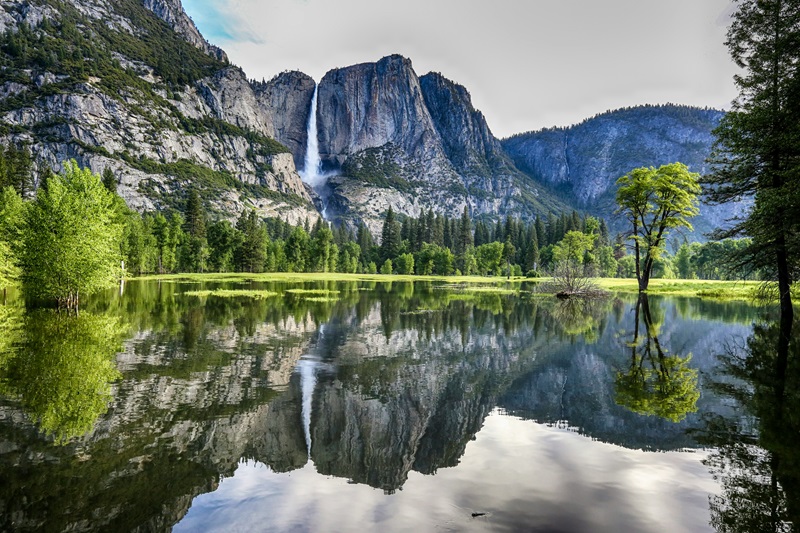
April (80% PWI) and May (83% PWI, 4 perfect days) are the waterfall months. Snowmelt from the high Sierra sends Yosemite Falls, Bridalveil Fall, and Ribbon Fall to their maximum volume — by July most of the smaller falls have slowed to a trickle or stopped entirely. May in particular hits a rare sweet spot: the waterfalls are at full force, temperatures in the valley are comfortable for long hikes, and the Half Dome cables are installed by late May for the season. Day-use reservations are required and should be secured well in advance for weekends.
Summer is Yosemite's busiest stretch, drawing 40% of annual visitors across June, July, and August. Valley temperatures are warm — highs regularly reach the mid-80s°F — but manageable for early morning hikes. The bigger concern in dry years is wildfire smoke, which can settle into the valley and push air quality into unhealthy ranges for days at a time. The reservation system is strictly enforced, Tioga Road opens for the high country, and Half Dome permit holders are hiking the cables daily. If you go in summer, start every hike by 7am before the heat and afternoon crowds build.
Winter brings Yosemite's lowest visitor counts and some of its most striking scenery. Snow on the granite walls and valley floor transforms the landscape. Tire chains or 4WD are often required for valley road access, and Tioga Road is closed. PWI scores range from 65–73% through winter — not ideal, but not hostile either on clear days. Badger Pass ski area operates December through March. January through March are when Horsetail Fall occasionally catches the late-afternoon light in a phenomenon locals call the "Firefall" — when conditions align, it's worth planning a trip around.
Yosemite's weather and accessibility vary dramatically by elevation. The PWI scores on this page reflect Yosemite Valley at approximately 4,000 feet — Tuolumne Meadows at 8,600 feet is significantly cooler and only accessible when Tioga Road is open, typically late May through late October.
Tioga Road is the defining access route for the high country — typically open late May through late October or early November depending on snowpack. Its closure marks the effective end of the Yosemite high season. Half Dome cables are installed in late May and removed in mid-October, defining the window for the summit hike. Permits are required and sell out months in advance — apply in the March lottery for the best chance of a permit.
What is the best time to visit Yosemite National Park?
October is the best month based on Perfect Weather Index scores — peak comfort, full valley access, and noticeably fewer crowds than summer. May is the best choice if waterfalls are a priority, combining excellent PWI scores with peak snowmelt flow on Yosemite Falls, Bridalveil Fall, and dozens of seasonal cascades. If avoiding crowds is the top priority, November and early April offer solid weather with significantly lower visitor numbers.
Do you need a reservation to visit Yosemite?
During peak season (typically late May through early September), a day-use reservation is required to drive into Yosemite Valley and some other areas. Reservations open on a rolling 28-day window and sell out quickly for weekends and holidays. Outside the reservation window — early spring, late fall, and winter — no advance reservation is needed for general valley access, though Half Dome permits are always required separately for the cable route and are allocated by lottery months in advance.
When are Yosemite's waterfalls at their best?
May is peak waterfall season at Yosemite. Snowmelt from the high Sierra drives Yosemite Falls, Bridalveil Fall, Ribbon Fall, and Nevada and Vernal Falls to their maximum flow. By July, lighter-flow falls like Ribbon and upper Yosemite Falls have often slowed to a trickle or stopped entirely in dry years. April can also be spectacular if winter snowpack was high. If you're visiting specifically for the waterfalls, aim for mid-May for the best combination of flow and comfortable hiking temperatures.
When does fall color peak at Yosemite?
Fall color at Yosemite typically peaks in mid-to-late October in the valley, where black oaks turn gold and orange against the granite walls — a striking combination unique to Yosemite. Higher elevations like Tuolumne Meadows see color earlier, usually early to mid-October, but Tioga Road may close by then depending on early snowfall. October's 85% PWI score means you get the fall color during the park's most comfortable weather month of the year.
What is the best time to visit Yosemite for international visitors?
October is ideal — peak weather comfort, fall color, and lower crowds than summer. May is the best spring option, with spectacular waterfalls and excellent hiking conditions. Yosemite is easily reached from San Francisco (approximately 3.5 hours by car) or from Fresno-Yosemite International Airport (about 1.5 hours). Many international visitors combine Yosemite with San Francisco and the California coast, or extend east to Sequoia and Kings Canyon National Parks.
What is the Perfect Weather Index?
The Perfect Weather Index (PWI) is a daily comfort score from 1–10 calculated from National Weather Service forecast data. It combines temperature, sunshine, humidity, wind, and precipitation into a single rating. A score of 8 or higher means genuinely excellent outdoor conditions. Scores below 4 reflect cold, storms, or other conditions that significantly limit outdoor comfort. Learn more about how the PWI works →