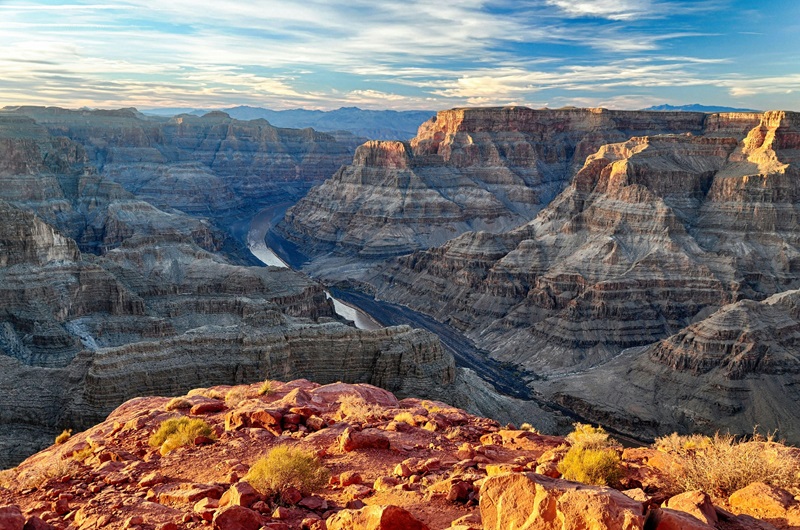
Grand Canyon National Park delivers some of the most dramatic weather data of any park in the system — October scores 86% PWI with 8 perfect days, the highest single-month perfect day count in our national park data. The canyon's extreme depth creates two entirely different weather experiences: the South Rim sits at 7,000 feet with temperate conditions, while the Inner Canyon floor near Phantom Ranch reaches 110°F in summer. Using Perfect Weather Index (PWI) scores calculated from daily National Weather Service forecast data, this page shows when to visit the rim, when inner canyon hiking is safe, and when the monsoon makes both dangerous.
Current Perfect Weather Index scores for the next 7 days at Grand Canyon National Park. Higher scores indicate more comfortable outdoor conditions. Updated daily using National Weather Service forecast data.
| Loading… |
|---|
| Loading… |
How to use this: Days with higher scores are generally better for hiking and outdoor activities, with more comfortable temperatures, lighter winds, and fewer weather impacts. → View official National Weather Service forecast for Grand Canyon
October is the best month to visit Grand Canyon by a significant margin — 86% PWI with 8 perfect days, the highest single-month perfect day count in our national park data.
Based on Perfect Weather Index (PWI) data from the South Rim (elevation ~7,000 ft) — drawing on NWS forecast records and historical climate normals — Grand Canyon shows a pattern that rewards fall and late spring visitors while strongly discouraging summer inner canyon hiking. May and November also deliver strong scores above 79% PWI. The monsoon season (July–August) brings humidity and afternoon storms that reduce rim comfort and make inner canyon conditions genuinely dangerous. These seasonal patterns are consistent with long-term climate data for the Colorado Plateau.
Raw monthly totals were normalized into monthly PWI scores (percent of possible points) and paired with the number of rare Perfect 10 days.
Monthly PWI scores reflect the percentage of possible comfort points earned at the South Rim across all days in each month, derived from National Weather Service forecast data and consistent with long-term climate normals for the South Rim area. Perfect 10 days are days scoring a full 10 out of 10 on the PWI scale. Inner Canyon conditions are dramatically hotter — these scores do not reflect Phantom Ranch or corridor trail conditions.
| Month | Monthly PWI Score | Perfect 10 Days | What It Means | Verdict |
|---|---|---|---|---|
| January | ~65% | 0 | Cold, quiet, winter conditions | Good |
| February | ~70% | 0 | Cool, improving reliability | Good |
| March | ~71% | 2 | Transitional spring weather | Good |
| April | ~79% | 0 | Mild, very good hiking | Very Good |
| May | ~79% | 2 | Warm days, excellent comfort | Very Good |
| June | ~73% | 0 | Early summer heat begins | Good |
| July | ~71% | 0 | Hot with monsoon influence | Good |
| August | ~69% | 0 | Humidity and storms linger | Good |
| September | ~78% | 1 | Cooling, more stable | Very Good |
| October ⭐ | ~86% | 8 | Outstanding, most reliable | Excellent |
| November | ~79% | 4 | Cool, crisp, quieter | Very Good |
| December | ~75% | 0 | Cold but generally stable | Good |
PWI scores based on NWS forecast data at the South Rim (~7,000 ft). The Inner Canyon is 20–30°F hotter and scores differently — these figures do not reflect conditions at Phantom Ranch.
Average monthly visitor counts at Grand Canyon National Park (2019–2023 average, source: NPS). Visitor numbers are remarkably consistent year-round compared to most parks — the lowest month (January) still draws 175,000 visitors. October delivers the best PWI scores while drawing fewer visitors than peak summer months.
| Month | % of Annual Visitors | Avg Visitors | Crowd Level |
|---|---|---|---|
| January | 4% | 175,848 | Low |
| February | 4% | 191,721 | Low |
| March | 8% | 402,019 | Moderate |
| April | 8% | 472,467 | Moderate |
| May | 10% | 551,570 | High |
| June | 10% | 496,170 | High |
| July | 11% | 538,554 | Peak |
| August | 10% | 507,709 | High |
| September | 10% | 471,930 | High |
| October ⭐ | 9% | 455,042 | Moderate |
| November | 7% | 334,942 | Low |
| December | 7% | 321,191 | Low |
Source: National Park Service visitor use statistics, 2019–2023 average.
October is Grand Canyon's standout month — 86% PWI with 8 perfect days, the highest single-month perfect day count in our national park data. The summer heat has fully dissipated on the South Rim, monsoon storms have ended, and temperatures are ideal for both rim walks and inner canyon hiking. The Bright Angel and South Kaibab trails are at their most comfortable in October. Visitor numbers are actually slightly lower than peak summer despite the superior conditions, making October the clear best choice for a Grand Canyon visit.
November scored 79% PWI with 4 perfect days — strong conditions with a significant drop in visitor numbers from October. The South Rim stays fully accessible and rim temperatures are crisp and comfortable. The North Rim closes in mid-November as snow becomes likely, so November is a South Rim month. Inner canyon hiking remains very comfortable in November — some experienced hikers consider it the best month for a Phantom Ranch corridor hike.
April (79% PWI) and May (79% PWI, 2 perfect days) both deliver excellent South Rim conditions. Spring is one of the two peak visitor seasons — April and May together draw 18% of annual visitors. Inner canyon temperatures are rising through spring but remain manageable for day hikes in April. By late May, temperatures below the rim begin to climb toward dangerous levels for unprepared hikers. Both months offer strong PWI scores and the canyon at its most vibrant with spring wildflowers on the rim.
Summer on the South Rim is manageable — June (73% PWI), July (71%), and August (69%) reflect warm but not extreme conditions at 7,000 feet elevation. The canyon rim is comfortable. The Inner Canyon is not. Temperatures at Phantom Ranch regularly reach 110°F (43°C) in summer, and the NPS strongly discourages day hikes below the rim between May and September. The combination of heat, exertion, and limited water sources has contributed to numerous heat-related rescues and fatalities. July and August bring monsoon thunderstorms — afternoon storms can be intense on the rim and create flash flood risk in side canyons.
Winter on the South Rim is cold — January and February see snow and temperatures below freezing — but the canyon remains spectacular and far less crowded than any other season. PWI scores range from 65–75% through winter. The North Rim closes in mid-October and reopens in mid-May. Inner canyon temperatures are ideal in winter, making December through February the best time for a Phantom Ranch rim-to-rim hike for experienced backpackers.
The Grand Canyon has three distinct visitor areas with dramatically different weather, access, and visitor experience. The PWI scores on this page reflect the South Rim — the most visited and accessible part of the park. The North Rim and Inner Canyon have significantly different conditions.
The single most important weather consideration at Grand Canyon is the temperature difference between the rim and the Inner Canyon. A comfortable 75°F day on the South Rim can mean 105°F at the river. Many heat-related emergencies involve hikers who felt fine at the rim, descended several miles, and found themselves unable to climb back out in the heat. The NPS recommends turning around at the 1.5-mile Resthouse on Bright Angel Trail for any day hike attempted between May and September.
What is the best time to visit Grand Canyon National Park?
October is the best month by a clear margin — 86% PWI with 8 perfect days and moderate crowd levels. November is the best value, combining 79% PWI with significantly fewer visitors. Spring visitors should target April or early May for rim hiking; inner canyon conditions become dangerous by late May. Summer is fine for South Rim walks but should be avoided for any below-rim hiking.
Is it safe to hike into the Grand Canyon in summer?
Hiking below the rim is genuinely dangerous in summer and the NPS strongly discourages it. Temperatures at Phantom Ranch regularly exceed 110°F between June and August, and the climb out is far more taxing than the descent. The NPS recommends that day hikers not go below the 1.5-mile Resthouse on Bright Angel Trail from May through September. If you visit in summer, stick to rim trails in the early morning or evening and save any below-rim ambitions for October through April.
What is the difference between the South Rim and North Rim?
The South Rim is open year-round, has the vast majority of visitor services, and is about 4 hours from Phoenix and 4.5 hours from Las Vegas. The North Rim sits about 1,000 feet higher, is open only mid-May through mid-October, and draws a fraction of the visitors. The two rims are 10 miles apart as the crow flies but about 215 miles by road. The North Rim offers a quieter, more forested experience with a different perspective of the canyon — many repeat visitors consider it the better experience precisely because it's less crowded.
When does the Grand Canyon monsoon season occur?
The North American monsoon typically arrives at the Grand Canyon in mid-July and persists through September. Afternoon thunderstorms build rapidly, often delivering intense lightning, heavy rain, and dramatic waterfalls cascading over the canyon walls. Flash flood risk in side canyons is real and can be triggered by storms miles away that aren't visible from the canyon floor. The monsoon reduces PWI scores in July and August but also creates some of the most visually spectacular conditions of the year for photographers on the rim.
What is the best time to visit Grand Canyon for international visitors?
October is ideal — the best weather of the year, moderate crowds, and full South Rim access. Spring (April–May) is the second-best window. Grand Canyon is within a day's drive of Las Vegas (4.5 hours), Phoenix (4 hours), and Zion National Park (2.5 hours), making it a natural anchor for a Southwest road trip. Many international visitors combine Grand Canyon with Zion, Bryce Canyon, and Monument Valley for a classic Utah-Arizona circuit.
What is the Perfect Weather Index?
The Perfect Weather Index (PWI) is a daily comfort score from 1–10 calculated from National Weather Service forecast data. It combines temperature, sunshine, humidity, wind, and precipitation into a single rating. A score of 8 or higher means genuinely excellent outdoor conditions. Scores below 4 reflect cold, storms, or other conditions that significantly limit outdoor comfort. Learn more about how the PWI works →